

Introduction
In this article, we present the different configurations for reintegrating oil recovered from the oil separator(s) into compressor crankcases.
The role of the oil separator is to separate the oil present in the refrigerant.
The recovered oil is reinjected into the compressor crankcase(s) via one of the oil return systems described below.
- Single compressor circuit
- Multiple compressor circuits
- High-pressure oil return
You can select separator with CARLYSOFT.
Single compressor circuit
In a thermodynamic system with a single compressor, oil separation is generally neglected.
However, it often becomes essential when distances between cold rooms (or refrigerated display cabinets) and the compressor are considerable.
The oil separator is then connected to the compressor discharge piping, allowing the separated oil to return directly to the compressor oil sump.
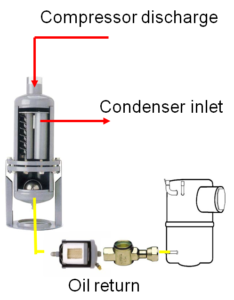
This type of installation is simple and highly effective.
Given the wide range of CARLY TURBOIL oil separators, it is possible to optimize their selection for small power ratings (< 80kW).
Multi-compressor circuit
Oil return to suction
In a circuit with several compressors in parallel (central plant), the oil management system must be adapted to suit the application.
For example, a multi-compressor system for a supermarket will not operate in the same way as a system for a cold store.
It is very important to take into account all the operating parameters of the refrigeration plant in order to select the most suitable oil separator(s).
Some principles of oil return management are described below.
Related products: TURBOIL / TURBOIL-F , HYDROIL, HCYVP
The oil in the suction manifold is drawn off by the compressors.
The pressure drops in the suction pipes between the compressors and the manifold are not exactly the same.
As a result, the quantities of oil sucked in by the compressors may differ from those expelled, leading to differences in oil levels between the compressor housings.
Abnormally high or low oil levels can lead to compressor damage or even breakage.
Maintaining an identical oil level between compressor crankcases can be achieved by adding a balancing pipe.
This pipe must have a sufficient cross-sectional area to :
- prevent siphoning between crankcases
- Balance oil levels between crankcases
- Ensure pressure balancing between crankcases.
(Refer to refrigeration compressor manufacturers’ recommendations).
Oil return to crankcases
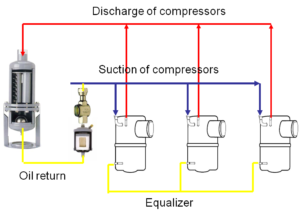
To minimize differences in oil levels in the compressor crankcases, oil can be returned directly to the compressors via the equalization piping.
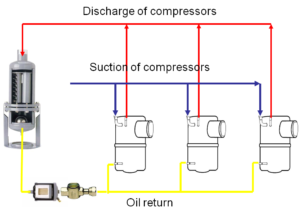
Related products: TURBOIL / TURBOIL-F, HYDROIL, HCYVP
Centralized oil return
This system is the most widely used when the refrigeration plant :
- supplies a large number of cold rooms or refrigerated display cases
- is located at a significant distance from the condenser(s) and evaporator(s).
When the system is commissioned, oil traps and siphons must be filled.
A sufficient oil reserve is essential.
The separated oil is returned to an oil tank.
The reservoir feeds the oil level regulators, whose role is to maintain constant oil levels in the compressor crankcases.
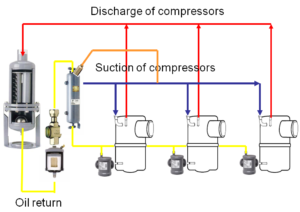
Related products: HCYCTR, HCYR, TURBOIL-R, HYDROIL, HCYVI, HCYVP
The oil reservoir is kept at excess pressure in relation to the compressor oil sumps, so as to ensure an adequate oil supply to the oil level regulators.
The oil reservoir is kept at excess pressure by a tared valve, which evacuates excess pressure to the suction manifold.
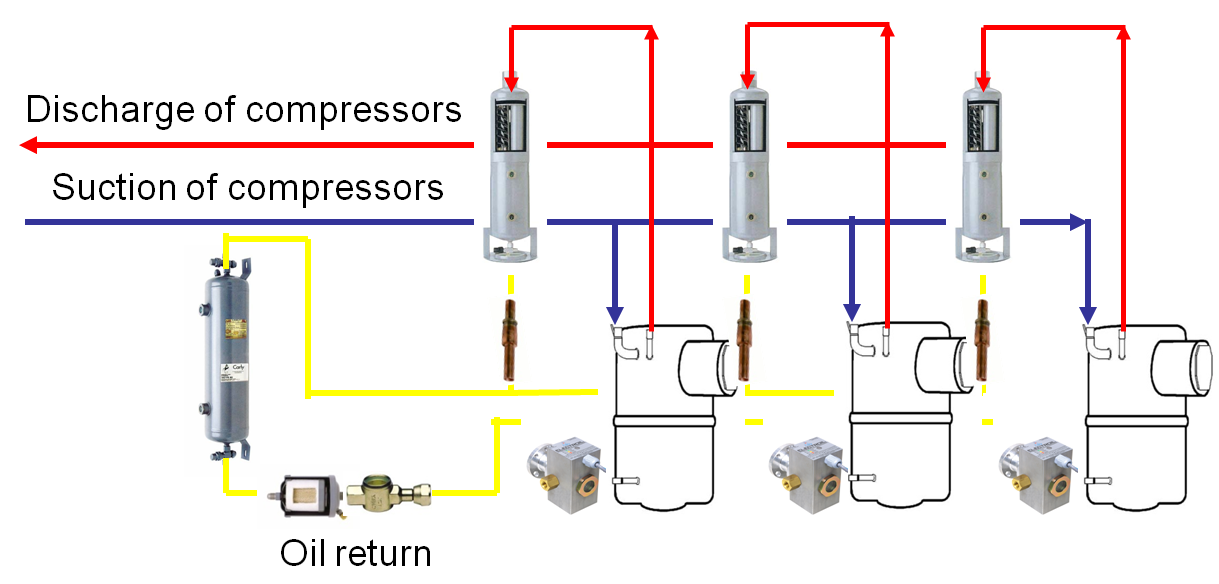
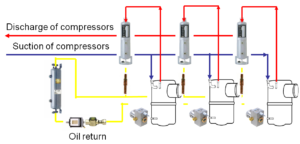
One oil separator by compressor
The oil separator is generally selected in relation to the maximum capacity of the refrigeration plant.
When the plant is equipped with more than 3 compressors, and only one compressor is in operation, variations in refrigerant flow rate can reduce the efficiency of the oil separator.
It is therefore recommended to install one separator per compressor.
This technique means there’s no limit to the number of compressors installed in parallel, and can be adapted to all types of application.
The combination of compressor and oil separator is generally easier, and the efficiency of the separator is always optimal.
Depending on the complexity of the installation, oil returns from the separators are made directly to the corresponding compressors or to an oil receiver.
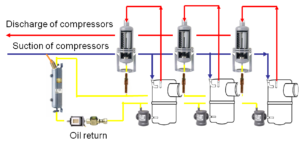
Related products: TURBOIL-R, LEVOIL, HYDROIL, HCYVI, HCYVP, HCYR, HCYCTR
High-pressure oil return
This technology uses oil separators without a float mechanism.
- The separated oil is stored in the lower part of the oil separator, making up the oil reserve.
- The oil is returned to the compressor crankcase via electronic or mechanical oil level regulators.
- This is because the oil is stored at high pressure and cannot be returned directly to the crankcases.
- The latter cannot operate with high-pressure oil return, as their operating principle is based on a balance of forces acting on a float.
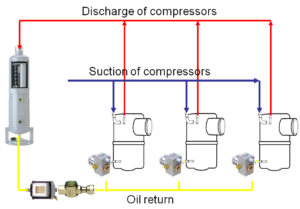
Related products: TURBOIL-R, LEVOIL, HYDROIL, HCYVI, HCYVP
Depending on the complexity of the installation, it may be necessary to use an additional oil tank.
The reservoir stores the quantity of oil needed to fill the system’s siphons and oil pigs.
Related products: TURBOIL-R, LEVOIL, HYDROIL, HCYVI, HCYVP, HCYR
additional information
The efficiency of an oil separator, whatever the technology used, is never 100%.
The use of an oil separator on a refrigeration plant does not exempt the designer and/or installer from complying with the rules of the trade (speed, distance, etc.).
The selection of an oil separator and the choice of an oil return circuit must take into account all the parameters of the refrigeration plant and its operation.